There are many ways to build toddler language skills, but finding specific advice can be tricky, especially if you feel your child isn’t picking up language as quickly as you expected. We’ve gathered actionable tips along with expert information on what typical toddler language development is. We also have ways to build toddler language skills that will help you add new routines into your daily life.
Building toddler language skills is all about engaging with your child, so as long as you are making quality time to talk with your toddler in any way, you’re on the right track. For more specific advice about how to use that time, read on.

What is typical language development for a toddler?
What is typical varies so much for every child and every child moves at his or her own pace. A child may be more focused on gross motor development one month and then explode her number of words the next. Still, there are certain general guidelines you can expect to see.
According to two foundational 20th-century studies, children are expected to reach the milestones of saying 10 words at 13 to 15 months, 50 words at 17 to 20 months, and having a vocabulary of 186 to 310 words at 24 months.
Dr. Jay L. Hoecker at Mayo Clinic says that by age 2, most children can speak 50 or more words. They can also use simple phrases such as “more milk,” ask one- to two-word questions, such as “go bye-bye?,” follow simple commands, and understand simple questions. Between ages 2 and 3, most children use between 200 and 1,000 words and speak in two- and three-word phrases or sentences.
What are the five stages of child language development?
According to a Linguistics course at the University of Pennsylvania, the five stages of child language development are as follows:
| Babbling | 6-8 months |
| One-word stage | 9-18 months |
| Two-word stage | 18-24 months |
| Early multiword stage | 24-30 months |
| Later multiword stage | 30+ months |
In the early multiword stage, children might say sentences like “Pig say oink” or “want get chocolate.” Grammatical elements are added in the later multiword stage, such as “I having this” or “her climbing that.”
How can toddlers improve language development?
Here are six ways to build toddler language skills.
Build on what they say
For example, if your toddler says “food,” say, “yes, yummy food.” Describe what they are talking about and add more words around the words already in use. Make comments instead of asking questions to keep it lower pressure. Always respond in some way to what your toddler says to encourage him.
Eliminate background distractions
Don’t leave the TV playing unless you are watching it together. Even music playing in the background, unless you are actively singing along or dancing to it, will distract from processing words.
Repeat, repeat, repeat
Saying the same words, again and again, is how toddlers will learn the word. You can do this naturally by using the word multiple times in a sentence such as “Do you like bananas? Bananas are yummy. I like bananas, too. See this banana here? This banana is yellow. Most bananas are yellow. Sometimes bananas are green or brown.” Just keep going and don’t switch out the word for a pronoun (i.e. “they are yummy”).
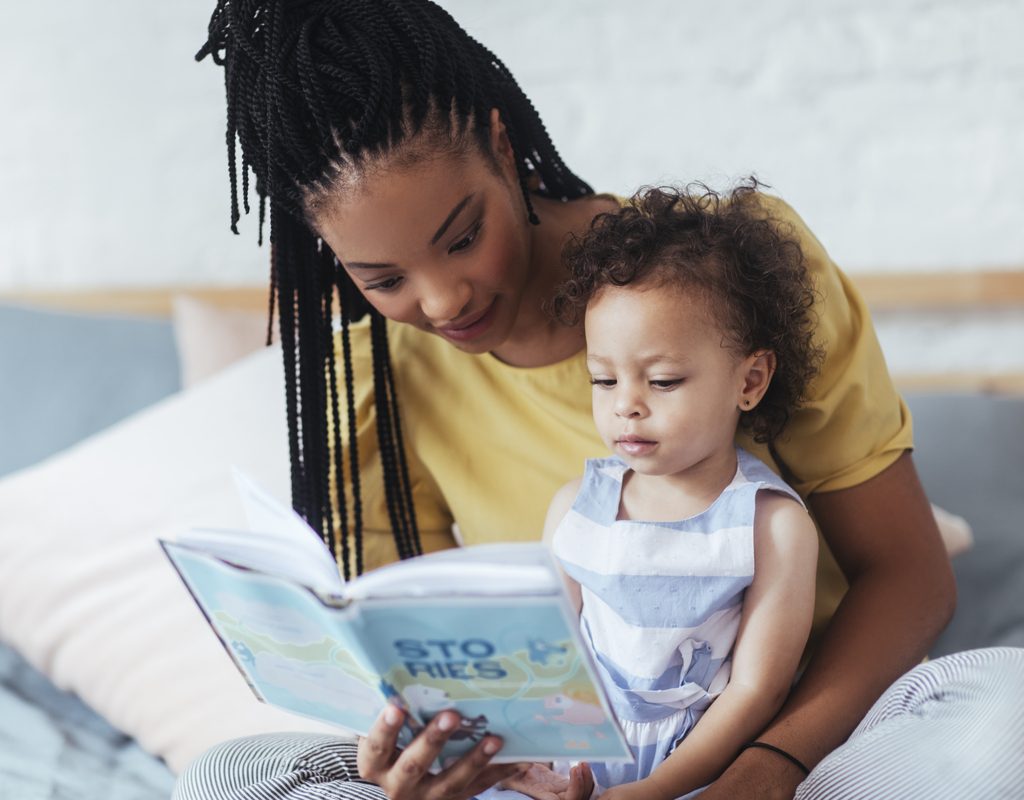
Read books together
Reading board books and picture books every single day is an important part of toddler language development. Toddlers don’t have to sit still — you can still read a book to your child while she plays. Nemours Children’s Health recommends reading slowly and expressively, using different voices for different characters, and changing the volume and pitch of your voice as your read.
Narrate what’s happening
Toddlers need to hear everyday language as much as possible to pick up on it, but sometimes, there just isn’t a lot to say. Narrating what’s happening is the easiest way to find a way to bring language into their lives. Simply describe what you and your toddler are doing. “You’re picking up the truck. The truck is red. You’re driving it along the carpet. The carpet is beige.” Just keep talking as much as you can.
Label praise
Instead of just saying “good job,” get more specific by saying “good job using your fork to eat.” This is an extension of the narration advice of getting in more words. Continue to find more and more ways to describe everything your toddler is doing.
Ways to build toddler language skills: It’s all about engagement
Simply keep describing everything you’re doing and your child is doing and adding in more and more words every chance you have. When they point to something, name it. When they name something, add another descriptive word like the color. When they play with something, talk about it. Just keep talking, and your toddler will start talking, too. If they don’t, bring it up to your pediatrician to discuss next steps.