Children go through many developmental stages, and it can be hard to keep up with all of the terms and buzzwords. You may have heard of parallel play and be wondering if it’s something your toddler needs to be working on or how to spot it if they’re already doing it. All kids are different, though parallel play is something you’re likely to see in most children as they grow up.
Read on for information on when kids start parallel playing, what it is and why it’s beneficial.
What is parallel play in child development?
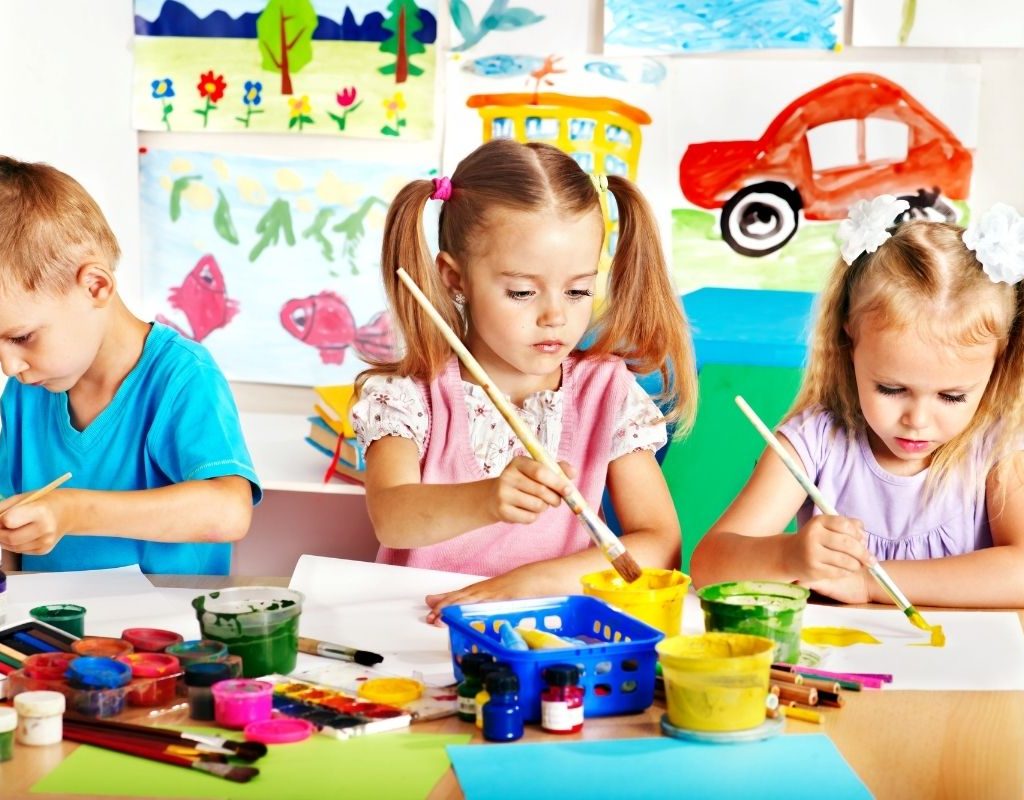
Parallel play is when a child plays by themself alongside another child playing, without them playing together. As in the image above, the children are all occupied playing but are not interacting. Children playing alongside each other who just happen to be in the same room are parallel playing.
In child development, there is a theory called Parten’s Stages of Play, which was developed by Dr. Mildred Parten Newhall in 1929. She categorized children’s play into six stages of development:
- Unoccupied play (birth to three months) – this is pre-play when a child just observes
- Independent play (birth to two years) – when a child is able to maintain focus on an activity on their own
- Onlooker play (two years) – when a child watches other children play but doesn’t yet join in
- Parallel play (2+ years) – when a child plays on their own but near other children
- Associative play (3-4 years)- when a child is interested in the others playing (the child is interested in the person playing but not yet in playing the same thing)
- Cooperative play (4+ years) – when a child is interested both in the person playing and in the play they are engaging in
As you can see, parallel play is the fourth stage and is part of the path toward cooperative play. Also called adjacent play, parallel play is a transitional phase between being too young to interact with others and becoming socially mature enough to play with others. Maintaining focus on their own activity without distraction is a developmental milestone of its own, but they’re not yet advanced enough to be able to play together with others.
These stages start at birth and children usually reach the final stage of cooperative play closer to kindergarten age. Your child may start engaging in parallel play as a toddler/preschooler.
Why is parallel play important for your child’s development?
Parallel play is a skill your child will likely develop naturally and is not something you necessarily have to encourage to make happen. It’s common around ages two to three. When you notice it, it’s an exciting sign that they’re on their way to cooperative play!
Playing alongside another child allows your child to engage in a quasi-social activity before they develop the social skills to play together. It lets them build confidence in what they are doing without having to share or compromise and lets them start moving away from completely solitary play. They can also pick up on beneficial language development and emotional understanding just from another child being in their periphery, and the play they do on their own can develop fine and gross motor skills. They can express themselves and learn through trial and error in their own play to develop the confidence to take those developed play skills into a social interaction.
Though your toddler may seem to be playing alone, they are keeping an eye on other children. This is their first dipping of a toe into group interactions. The observation skills they are gaining and seeing how the other child reacts to frustration or success in their play are all helping them develop. They’re learning from everything the other child does, says, and learns. It is a key bridge to eventually playing together.
Parallel play is a natural and important developmental milestone for kids around two years old. As the bridge from being a solitary baby to being a social school-age kid, it’s an exciting step towards years of happy playdates to come. There’s no need to rush this stage; it will all come in time. Enjoy the period while your child occupies themself with their own play, and you can get some chores done parallel to them while they do!