
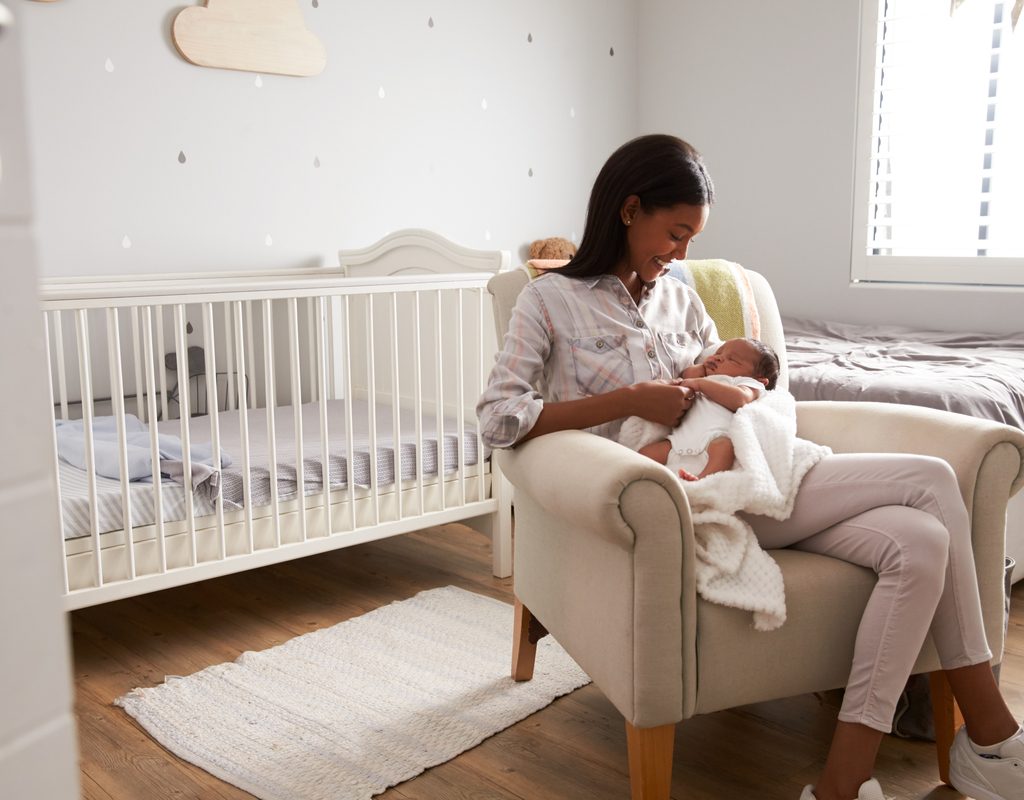
Those first few days and weeks after your newborn comes home from the hospital are filled with happiness, but they are also trying too. As parents adjust to having a newborn in the house, it can be difficult to find time for your own personal care as well as household chores. Even taking a shower on some days seems like a luxury.
Now, if your newborn wants to be held all night or while napping, it can be even more challenging. Just finding the time to get some sleep yourself is like a pipe dream. Why do some babies want to be held constantly while sleeping? The first step is understanding why newborns want to be held all night, what you can do to manage, and when baby will sleep in a crib. Don’t worry. Just because your newborn wants to be cuddled while sleeping doesn’t mean you won’t be able to.

Your newborn wants to be held all night
The relationship between a parent and their baby is complex and beautiful. While cuddling, your baby can actually hear your heartbeat, and your presence is soothing. Babies also smell your scent when you hold them, making them feel safer. When babies are under four months old, they’re still getting used to life outside the womb. The new surroundings can be scary and unfamiliar.
It takes time for them to become accustomed to this new environment. When parents hold their babies, they feel warm and safe, just like in the womb. While this is a wonderful time for parents and baby, this comforting and cozy bonding can turn into a problem if new parents aren’t careful.
When your baby falls asleep in your arms too often, it can become a habit. Falling asleep in mom or dad’s arms can ultimately become a hard habit to break. Your baby might associate sleeping with being in your arms and will consequently have trouble sleeping anywhere else, like their own crib.

Comfortable ways to hold babies while sleeping
Holding babies isn’t challenging, but sometimes it can be difficult to find an agreeable position when they are sleeping. When babies doze off, there are three ways they might find the most soothing.
Cradling
Cradling a baby may just be the most common position for holding your baby. It tends to be a natural holding position and is quite simple. Your baby’s head will gently rest in the crook of one arm while your other arm is wrapped around them, securing your baby while they sleep. Cradling makes rocking your little one to sleep easy.
On your shoulder
Another classic baby-holding position is on a shoulder. Let your baby lean their cheek against your shoulder while you support their bottom, as well as their back and neck. This position may make it easier to gently bounce your baby to sleep. Your baby will be able to hear your rhythmic breathing and heartbeat, too. So, it’s a relaxing and comforting sleeping position for a baby to fall asleep in.
In a sling
Using a sling is also helpful for sleeping babies. It lets you hold your baby hands-free while giving your baby the comfort of being held. Your baby will be able to stay close to you, but you’ll be able to do other things while your baby rests. This can be a lifesaver if your baby is reluctant to be put down in those early days.

How and when to put your baby in their crib
When to start putting your baby to sleep in their crib is a personal decision. For many parents, that magic time is around six months old. Before that, it’s a good idea to get your little one used to the crib. Introducing a baby to the crib before you plan on doing it at night makes the transition easier. These are some ways to make transitioning to the crib less stressful for baby and parents.
Use the crib for naptime
You can start the transition into the crib by using it during naptime. When it’s time for your baby’s nap, start by placing the baby in their crib. Slowly and gradually introducing your baby to the crib during naptime helps your little one get used to sleeping in it at night.
Your baby’s behavior will let you know when they are ready to go to sleep. Common sleepy symptoms include becoming fussy, yawning frequently, rubbing their eyes, or looking away. If you notice one or more of these behaviors, your baby is probably ready to go to sleep.
Make sure you place your baby in their crib when they are sleepy but not actually asleep. If the baby wakes, comfort your baby by patting them, but don’t take your baby out of the crib because that will negatively impact their routine.
Use technology for support
Transitioning your baby to a crib can be more difficult for you than for your babies. Using a baby monitor helps ease your mind if you’re a parent anxious about your baby sleeping in their own crib in a room alone. There are even some mobile applications that can turn your tablet or phone into a baby monitor.
It’s completely normal if your baby doesn’t sleep through the night yet. Once your baby is about four to five months old, they may be able to start sleeping around seven hours per night. As your baby starts to inch into infanthood, you may no longer have a baby who wants to be held all night. Instead, you might have a baby who welcomes snuggling in their own crib.

Tips for sleep training your baby
A baby doesn’t just naturally adjust to sleeping solo in a crib. It takes time, patience, and a bit of sleep training for that magical time when you and your baby get a full night’s sleep.
Try swaddling
During the first few weeks, your baby is adjusting to the “outside world” after dwelling in a snug, warm environment for the last nine months. Naturally, recreating that safe space can help if your baby only sleeps when held.
Swaddling is the best option when it comes to soothing your baby to sleep, especially during the first two weeks. In the womb, your baby was accustomed to having limbs tucked in and snug. When you swaddle your baby, you’re placing them in a similar position, particularly with what’s called the “burrito wrap,” which is the most common form of swaddling.
Incorporate white noise
Using white noise during sleep also works well with swaddling. The soft humming and swooshing closely resemble the sounds from the womb. Your baby is reminded of that secure and comfy. White noise can help baby adjust during the more difficult sleep cycles and encourage baby to stay asleep longer. A device like the Fitniv white noise machine provides an effective option when your newborn won’t sleep unless held.

Developing healthy sleep habits
A common question among new parents is does your baby sleep through the night? Most of the time, the answer is no, but then who does actually sleep through the night? Very few of us have good sleep hygiene. Some of us struggle to fall asleep, while others wake up throughout the night. Then there’s those of us who can’t fall back to sleep when we wake up. Developing healthy sleep habits in children goes a long way toward helping them have good sleep hygiene when they hit adulthood. It may sound weird, but developing healthy sleep hygiene begins fairly early on and starts with a soothing bedtime routine.
Even newborns can begin to have a bedtime routine. During the day and even during naptime, have the curtains open and the shades up. When it’s time for everyone to wind down at night, start turning the lights down. This helps babies begin to understand the wake and sleep cycle routine over time.
A nightly bath followed by a story is the beginning to a comforting bedtime routine. You will give baby a bottle just before going down. Of course, you and your baby will want to enjoy some snuggling time before drifting off to sleep. This is fine, but you don’t necessarily want this snuggle time to become a component of a bedtime routine.

Should babies be held while sleeping?
Although you want to encourage healthy sleep habits when your baby is young, that doesn’t mean you can’t hold a baby when he or she is sleeping. Child sleep consultant Alexis Dubief explained to Today’s Parent that it’s only natural for a baby to want to be held while sleeping and that it’s OK to do sometimes, as long as you follow one rule.
“Having a newborn sleep on you is fine as long as you’re awake,” Dubief explained. “But chances are, you’ll fall asleep when you’re in this position, and safety concerns become an issue.” She also reiterated that if your child becomes accustomed to falling asleep in someone’s arms or against a warm body, at some point, it will be very difficult for them to fall asleep on their own.

Nighty night
Although the process can be frustrating and exhausting, remember that babies don’t learn to fall asleep on their own in a day. It takes time and repetition, especially if your newborn wants to be held all night. The best thing you can do for yourself, and your baby is to remain patient and consistent. Try these tips for helping your baby to learn to sleep on their own while setting the foundation for good sleep hygiene. Your pediatrician can also be a source of information and guidance during this difficult and sleep-deprived time.