  1. Home
  2. Activities
  3. Evergreens

NewFolks may earn a commission when you buy through links on our site.

Creative and fun ways to display your kids’ artwork – that don’t include the refrigerator

Add as a preferred source on Google

Back in the day, the refrigerator was the hall of fame for the home. Report cards, photographs, awards, and of course, artwork were often the center of attention on the fridge. Today with most things going digital, the refrigerator isn’t necessarily used for display, and with good reason. Those magnets mom used to use do not hold much, especially when it comes to art projects.

There’s an abundance of amazing craft ideas for kids – and whether they’ve come up with these on their own or they’ve taken inspiration from some outside source – your little ones have most likely created a multitude of colorful splashes and strokes and etches at home, school and camp. Children love to see their artistic creations take center stage and child art displays are a fun way to brighten up a space. Unfortunately, the amount of artwork kids generate, especially in families with more than one child, is enormous. Let’s face it. The refrigerator just isn’t that big, which is why you need creative and attractive ways to best display kids’ artwork around the home that delivers on function and style.

Recommended Videos

Now, don’t worry. The internet does not have a shortage of innovative ways to display children’s artwork. We’ve made it a snap to find the best ways to display kids’ artwork, whether you have a lot of space or a little.
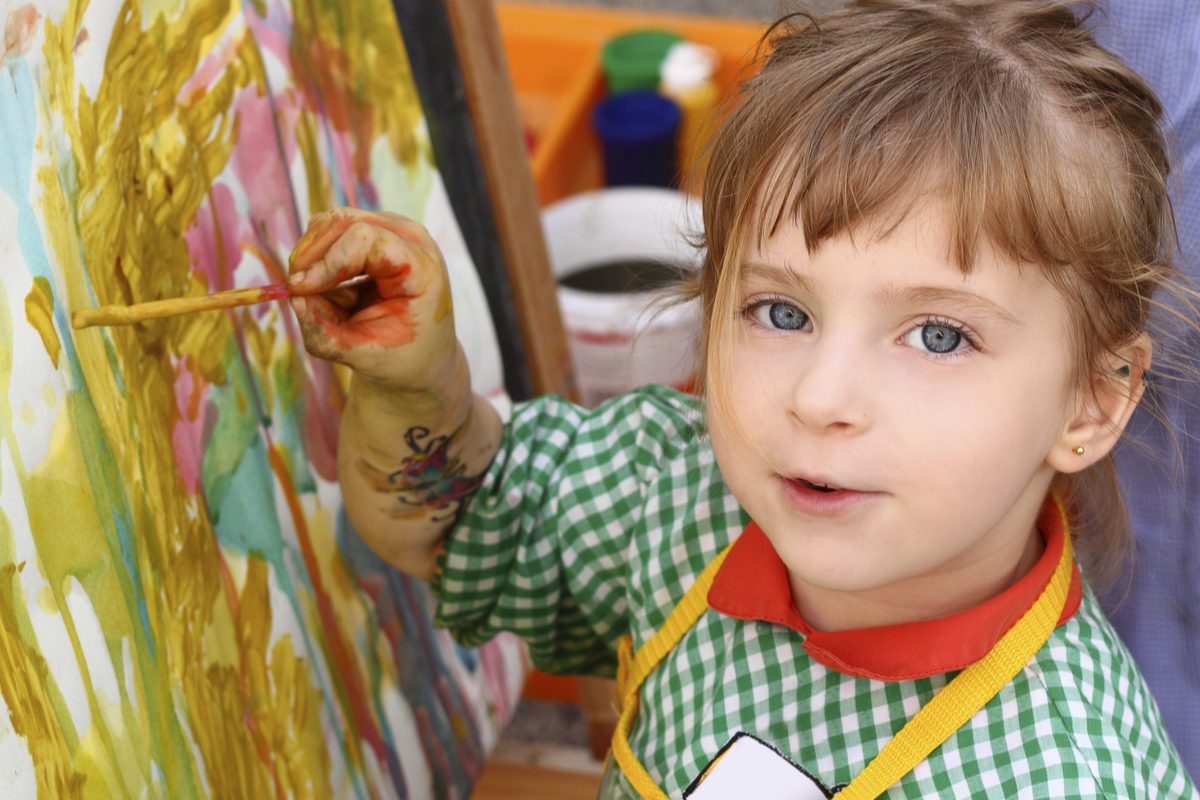
Little girl painting a picture on an art easel
Lunamarina/Shutterstock

Frame it

Putting a child’s artwork into a frame is a fantastic way to make a whimsical wall arrangement. You can go a couple of different ways with frames. An inexpensive way is to hit the dollar store and pick up a bunch of frames. Remove the matting and glass. Attach your child’s latest artistic endeavor with removable putty. Using putty instead of glue or tape allows you to quickly change the work of art in the frame. Make an eclectic arrangement on the wall with the frames featuring the kids’ artwork. The result is a charming display that can be easily switched up as the seasonal projects roll in. Floating shelves are another option for highlighting artwork frames.

Storage frames solve the problem of what to do with the artwork when you take it down. A storage frame opens from the front and comes with built-in storage. Some storage frames can hold up to 50 pieces of kids’ artwork and are often sold in sets of two.

If your child inherited their artistic flare from you, paint some frames on the walls of your child’s room. Then, use the space inside the frames to display their artwork.

Hang it

The kitchen isn’t the only spot in the house to display kids’ artwork. Playrooms, family rooms, and children’s rooms are perfect picks for showcasing children’s creative works. With a little ingenuity, you can find clever ways, even if space is a challenge.

Corkboards work well and can be hung on bedroom doors to highlight special art projects. Another way to give multiple projects a prized spot in the home is by hanging a clothesline. Teachers have been using this art display trick for a while. Run a clothesline across the playroom wall or even in a hallway, and you have an instant art gallery wall. All you need is some bright clothes pins to clip the artwork to the line. Use colored clothespins to add to the fun design. Instead of a horizontal clothesline, you can go vertical with hanging wire. Cut the desired length of wire and attach it to the wall using small self-adhesive hooks. Hang up one wire or more if you have a lot of kids’ artwork to display or allot one to each child. Artwork can be held into place with clips or powerful magnets.

If you want to get your creative juices flowing, transform skirt and pants hangers into frames. You can use the pants hangers as is and slip your child’s latest painting or project in. Dress them up by using colorful Painters Tape. You can then make a gallery-style display on the wall in the playroom or your child’s room.

Not a do-it-yourselfer? That’s okay; not everyone is. You can look like a DIY expert by using wall-mounted displays specifically designed and sold to hang children’s artwork. Several options on the market are variations of the clothesline and hanging wire creations. These kits come complete with clips.

Book it

Another cute way to display your child’s artwork and create a treasured keepsake is to make their masterpieces into a book. If you love to scrapbook, take your child’s projects and turn them into an annual scrapbook of all their school year collections. For a more digital approach, check out apps like Artkive that do the work for you.

Chalk it

This nifty DIY project made the rounds on social media, and it certainly is innovative. Using magnetic paint, you can turn an entire wall into a giant art gallery. Of course, you don’t have to do an entire wall. You can choose a section instead. Since the paint is magnetic, you can hang children’s artwork using magnets. Painting experts recommend multiple coats if you decide to create a magnetic chalkboard wall to display artwork.

Whatever way you choose to display your child’s artwork, the end result will bring a huge smile to your child’s face and yours. Showcasing children’s artwork is a wonderful way to bring color and texture to empty spaces in your home. Kids’ artistic creations are always attention-getters, especially when family comes to visit.

Need more inspiration for outdoor painting activities? Check our ideas on easy sidewalk chalk art for your kids.

Experts weigh in: Why YouTube isn’t great for kids
You may rethink screen time after you know what experts say about kids watching YouTube
Young boy on an iPad

It's a parenting tale as old as time. You have things to get done around the house, but a small person who says they're bored is competing with your to-do list. And so, you do what many parents do in this stretched-thin situation. You turn on the television, hand over a cellphone, or put on YouTube. But when it comes to kids watching YouTube, is it doing more harm than good?

Screens can be "addictive," as noted by Dr. David Greenfield, founder and clinical director of The Center for Internet and Technology Addiction. He explains that they have a dopamine-producing effect, and many realistic pediatric experts agree that, while screens are a part of our modern lifestyle, moderation should be enforced, and limitations be set. Parents need to learn why they should be mindful of children watching YouTube and how to lay down the screen time law at home. We'll share some tips and words of wisdom from experts in the know.
Why screen time could be negative

Read more
The best low-stimulation movies for calming toddlers
Make sure movie time does keep your toddler awake
Cute toddler watching a movie on a laptop

Screen time isn't always a bad thing for toddlers. Sometimes, when your little one isn't feeling well, watching a soothing movie is a perfect pick. Low-stimulation movies for toddlers offer better quality screen time than movies that are loud and packed with action. Sure, those are fun and can be super exciting for kids, but the impact on their cognitive development is often negative. Those overstimulating movies can be too much for toddlers, leading to tantrums, meltdowns, and an inability to fall asleep.

Think about how difficult it is to fall asleep after watching a horror or suspense movie right before going to bed. Your mind is going in different directions, making it hard to relax and drift off to sleep. Well, it's the same for toddlers. So, what are the best low-stimulation movies for toddlers to watch and what exactly are they?
Best low-stimulation movies for toddlers

Read more
When should your baby be able to stack blocks? Here’s what to know
Know when babies can nest cups and balance blocks by themselves
A child playing with stacking blocks

When you’re a new parent, the moment someone gifts your child their first set of blocks, you become obsessed with baby learning and when they should be able to turn the blocks into beautiful creations of their imagination. While stacking blocks are an important developmental milestone for babies, it’s also one of those things that evolves with time and practice. Sitting down to play blocks with your little one is an open-ended game that teaches children physics, resilience, and fun. When can a baby stack blocks and nest cups on their own without your help? Here are some general guidelines so you know how to measure your child’s development with their gift of stacking blocks and how to help your child get the hang of it on their own.
When can a baby stack blocks and nest cups? By age

By 6 months old
At this age, your baby might not be ready to stack blocks the way you want them to, and that's okay. This doesn't mean you can't play blocks with your child or that you shouldn't let your child have fun figuring out what the blocks are. It’s perfectly normal for your 6-month-old to gnaw on blocks or simply hold one, just don't expect them to build the Eiffel Tower just yet.
By 12 months old
This is the stage of banging items against each other and blocks or cups are no the exception. If you offer your child blocks, there may still not be a lot of creativity yet. But keep in mind that knocking things down is a favorite activity of 1-year-olds, so your child is right on track if that's all they do. More likely than not, they’ll be happy to destroy any block tower you build. If your little one can’t get enough of knocking down a stack of blocks, rest assured that they’re right on schedule.
By 18 months old
When can babies nest cups? By a year and a half, stacking is the name of the game. After all, your little one is now officially a toddler and proud of it. If you haven’t done so already, this is a great time to introduce baby blocks. At this point, most kiddos are able to stack two or three blocks on top of each other with ease.
By 2 years old
Don’t be surprised if your baby’s block masterpieces start to get taller by age 2. With improved coordination, your child shows better stacking skills and may be able to balance up to seven blocks on top of each other. This is the beginning of sorting for many young children. If they’re now stacking masters, go ahead and challenge your budding genius to sort their blocks by color or separate them in groups.
By 3 years old
Free play takes a life of its own by age 3. At this point, blocks are much more than meets the adult eye. Your child’s imagination is flourishing, and they’ll start to build tunnels, bridges, or forts with just a few blocks. This is the perfect moment to introduce your toddler to teamwork. If the two of you work together, it’s easier to build tall towers and solve construction problems. Get your child's imagination to full speed and see what they create with blocks of all colors and shapes.
The benefits of stacking blocks

Read more