  1. Home
  2. Activities
  3. Inspiration
  4. Evergreens

The best night lights for kids that won’t keep you up all night

Add as a preferred source on Google
Image used with permission by copyright holder

Is your little one afraid of the dark at bedtime? If so, they are definitely not alone.  According to Beverly Hills family therapist Dr. Jenn Berman, “The fear of the dark tends to evolve around the time children are old enough to have a sense of imagination.” Usually around the toddler years, around ages 2 to 3, bring about the child’s first fears of the dark, says Berman, due to they’re being “old enough to imagine, but not wise enough to distinguish fantasy from reality.”

With this combination at work, it’s not hard to see why a child may envision a monster standing in their darkened closet instead of the clothes that are actually hanging in there. This makes it harder to train your toddler to sleep through the night. So what can be done? Enter the night light. But not just any night light — the right kind of night lights introduce just enough light to a darkened room to illuminate the real and ditch the imaginary scary stuff so your little one can sleep soundly without the rest of the household being kept awake. To simplify things, we went in for the best of these night lights and rounded up a few for your consideration. Check out our favorite night lights for kids that won’t keep you up all night:

Recommended Videos

Twilight Turtle

Image used with permission by copyright holder

A bonafide favorite of some littles we know personally, the award-winning Twilight Turtle from Cloud B is a lovely addition to any child’s room, especially since each shell is beautifully and uniquely hand-painted!

This plush and soft turtle can light up in soothing hues of amber, blue, or green, and the push of a button on its shell sends a your choice of a slew of glowing stars and a crescent moon, or eight constellations onto the walls and ceiling. The gentle glow of the stars produces a relaxing effect which lulls your little one to sleep. The enclosed Star Guide shows children and their parents how to locate each of the eight constellations, and the story included tells the tale of how Twilight Turtle got lost one day and had to use the constellations to find his way back home.

The single press of a button keeps the constellations lit up for 45 minutes, after which Twilight Turtle shuts down, thinking your baby has fallen asleep. If they haven’t? Just press the button again for another 45 minutes. Comes in several colors including pink, blue, purple, aqua, and classic ladybug. Get your Twilight Turtle in classic here for $30.00.

Soothe and Glow Seahorse

Image used with permission by copyright holder

Another favorite of the kiddos we checked with is the adorable Soothe and Glow Seahorse from Fisher-Price, a soft and cuddly sleep-time pal that glows, makes music, and emits “white noise” sounds. To get the seahorse started, all your little one needs to do is give it a hug: this begins 5 minutes of music including 8 lullabies and various ocean sounds, as well as a gentle glowing light from the belly of the seahorse. After the 5 minutes is over, the seahorse’s belly light begins to grow dimmer and the music gets softer until it shuts down. Want to start it again? Just give it another hug!

Is it too loud? Just adjust the volume as you wish for your kiddo’s preferences. Did you spill something on it? No worries — it’s totally machine-washable once you remove the electronic parts from the center. This night light is perfect for any age, especially when it’s time to learn self-soothing. Get your Soothe and Glow Seahorse here for $13.00.

Hatch Baby Rest

Image used with permission by copyright holder
This innovative night light also features a sound machine and wake-up tool (called ‘time-to-rise’), and is ideal for at least somewhat tech-savvy parents. Once connected through the app on your phone (or you can simply connect to the night light by hand if in the same room), select the category you want to adjust. If you choose the sound machine, a wide assortment of sounds appears for you to choose from to help your baby fall asleep. To adjust the lights, select from an entire rainbow of colors to lull your little one off to dreamland, and to set the time-to-rise tool, you’ll create a sequence of both sounds and colors to assist your babe with the transition from sleeping to awake (or vice versa).
The device itself weights 13 ounces and it stands 6.25 inches high and 4″ in diameter. To clean, wipe with a dry soft cloth. Get your Hatch Baby Rest here for $60.00.

Remote Control Ocean Wave Projector 

Image used with permission by copyright holder

This cutting edge nursery light projector creates the optimal rejuvenating atmosphere for a young one’s bedroom. The 7 aurora lights whirl on the walls and/or ceiling and various ambient ocean sounds (Enjoy sounds like forest animals, sea gulls at the beach, flowing water and birds, as well as jovial nature sounds), of the Remote Control Ocean Wave Projector offer a brilliant compilation for setting up sleep mode.

Connect via the app through your phone, or simply use the device manually. (You can also connect with other devices to access even more music.) Once set up, you should be able to adjust and use the device’s built-in music player and ambient sound maker as you wish; if not, it’s possible something went wrong as you installed, so unplug it and start all over. Enjoy a video demo here. The product offers touch key and remote functioning for convenience.

Get your own Remote Ocean Wave Projector here for $23.00.

We think these four are the best to start with for this season’s night lights, and we’re fairly sure they won’t keep any adults awake as they lull your young sweethearts to lala-land. So which do you think you’ll choose? Some aren’t strictly a night light (lookin’ at you, Seahorse), but they do a great job acting as one and will probably offer a multitude of sleep-inducing songs and ambience as the nights go forward. Aside from that, please let us know how your little one enjoyed their night light, where you’re located, and even send a pic if you get any cute ones. We’d love to hear how your nights have gone since grabbing one of these (or a similar) night light.

Is CoComelon ‘Good’ for Kids? Experts Cite Research Pointing to ‘Yes’
Dad brushing teeth with daughter and looking in the mirror with CoComelon

Parents navigating the landscape of kids’ media often question which content genuinely benefits their little ones. Among the most popular kids’ shows today, educational programming like CoComelon has captivated young audiences worldwide, but many caregivers wonder: beyond its ability to entertain, does this musical series offer real developmental value?

Research and child development experts have revealed many details about the educational framework behind the animated series, its potential benefits, and how caregivers can maximize positive outcomes when incorporating such content into their kids’ routines.

Read more
The best low-stimulation movies for calming toddlers
Make sure movie time does keep your toddler awake
Cute toddler watching a movie on a laptop

Screen time isn't always a bad thing for toddlers. Sometimes, when your little one isn't feeling well, watching a soothing movie is a perfect pick. Low-stimulation movies for toddlers offer better quality screen time than movies that are loud and packed with action. Sure, those are fun and can be super exciting for kids, but the impact on their cognitive development is often negative. Those overstimulating movies can be too much for toddlers, leading to tantrums, meltdowns, and an inability to fall asleep.

Think about how difficult it is to fall asleep after watching a horror or suspense movie right before going to bed. Your mind is going in different directions, making it hard to relax and drift off to sleep. Well, it's the same for toddlers. So, what are the best low-stimulation movies for toddlers to watch and what exactly are they?
Best low-stimulation movies for toddlers

Read more
When should your baby be able to stack blocks? Here’s what to know
Know when babies can nest cups and balance blocks by themselves
A child playing with stacking blocks

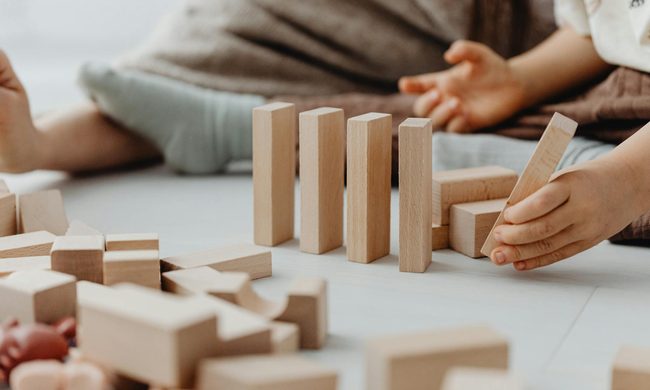
When you’re a new parent, the moment someone gifts your child their first set of blocks, you become obsessed with baby learning and when they should be able to turn the blocks into beautiful creations of their imagination. While stacking blocks are an important developmental milestone for babies, it’s also one of those things that evolves with time and practice. Sitting down to play blocks with your little one is an open-ended game that teaches children physics, resilience, and fun. When can a baby stack blocks and nest cups on their own without your help? Here are some general guidelines so you know how to measure your child’s development with their gift of stacking blocks and how to help your child get the hang of it on their own.
When can a baby stack blocks and nest cups? By age

By 6 months old
At this age, your baby might not be ready to stack blocks the way you want them to, and that's okay. This doesn't mean you can't play blocks with your child or that you shouldn't let your child have fun figuring out what the blocks are. It’s perfectly normal for your 6-month-old to gnaw on blocks or simply hold one, just don't expect them to build the Eiffel Tower just yet.
By 12 months old
This is the stage of banging items against each other and blocks or cups are no the exception. If you offer your child blocks, there may still not be a lot of creativity yet. But keep in mind that knocking things down is a favorite activity of 1-year-olds, so your child is right on track if that's all they do. More likely than not, they’ll be happy to destroy any block tower you build. If your little one can’t get enough of knocking down a stack of blocks, rest assured that they’re right on schedule.
By 18 months old
When can babies nest cups? By a year and a half, stacking is the name of the game. After all, your little one is now officially a toddler and proud of it. If you haven’t done so already, this is a great time to introduce baby blocks. At this point, most kiddos are able to stack two or three blocks on top of each other with ease.
By 2 years old
Don’t be surprised if your baby’s block masterpieces start to get taller by age 2. With improved coordination, your child shows better stacking skills and may be able to balance up to seven blocks on top of each other. This is the beginning of sorting for many young children. If they’re now stacking masters, go ahead and challenge your budding genius to sort their blocks by color or separate them in groups.
By 3 years old
Free play takes a life of its own by age 3. At this point, blocks are much more than meets the adult eye. Your child’s imagination is flourishing, and they’ll start to build tunnels, bridges, or forts with just a few blocks. This is the perfect moment to introduce your toddler to teamwork. If the two of you work together, it’s easier to build tall towers and solve construction problems. Get your child's imagination to full speed and see what they create with blocks of all colors and shapes.
The benefits of stacking blocks

Read more