  1. Home
  2. Activities
  3. Inspiration
  4. Evergreens

NewFolks may earn a commission when you buy through links on our site.

Try these realistic parenting resolutions for 2023 – the entire family can benefit

These achievable resolutions can up your parenting game

Add as a preferred source on Google

New Year’s resolutions usually focus inward. The usual suspects — getting in better shape, quitting smoking, and reading more — are noble goals, but tend to center on the individual. Resolutions, however, can also extend to the people around you — most notably in your household. In fact, taking a wider lens on your resolutions can present a golden opportunity to assess parenting habits and family relationships.

It is the rare (if not mythical) family that won’t benefit from healthy scrutiny and fresh ideas. We’ve done our research to find several New Year’s resolutions for parents in 2023 that you can do with your partner, children, or extended family that could have lasting benefits for the entire squad.

Girl makes New Year's resolution
Image used with permission by copyright holder

Why make a parenting resolution?

It’s more than a chance to change behavior. Parenting resolutions are a low-pressure way to bring your family together around a common cause or interest — something that screen time now makes more difficult than ever. (And we’ll return to that sticky wicket momentarily.)

Recommended Videos

This is a way to create positive change without making it a “punishment.” Establishing aspirations and working toward them together fosters excitement and team morale, not to mention direct positive impacts on day-to-day life.

Family rings in the New Year

Parenting resolutions for 2023

From time-honored standards to the here and now, these ideas can up your parenting game and improve your family’s well-being in the new year.

Diet and exercise

It makes sense to kick this off with what is likely the most common New Year’s resolution — and one of the most persistent health challenges — in the American playbook today. According to the Centers for Disease Control and Prevention, fewer than one in 10 adolescents and adults eat enough fruits or vegetables, while only 1 in 4 adults and 1 in 5 high school students reach recommended levels of physical activity.

Make this challenging, long-term work a family affair. Provide each other with support and motivation. But be realistic and creative.

  • Go to the park or pool as a group.
  • Consider investing in bicycles or appropriate fitness equipment.
  • Take the stairs.
  • Consume less soda and other sugary drinks.
  • Find a family-friendly sport, class, or activity-based video game.
  • Try plant-based alternatives to burgers and other less-healthy staples.
  • Experiment with juice or smoothie recipes.

These are just a few possibilities. Think about what’s most likely to not only draw initial attraction, but sustained interest over time.

Extended family volunteers
ESB Professional / Shutterstock

Volunteer

What are some of the passions you and your family share? If feasible, this could be a great time to involve your extended family, either by asking for input or inviting them along for an event.

Possibilities could include:

  • Helping the underprivileged.
  • Assisting animals, perhaps at your local shelter.
  • Restoring and protecting the environment.
  • Taking part in a fundraiser for a disease that has affected a loved one.
  • Engaging with communities of faith.

If you try an activity or group that doesn’t resonate, try another one! Don’t get discouraged. It might take some time, but stay committed and you’ll find your niche.

Kids watching screens in secret
Africa Studio / Shutterstock

Limit screen time

A 2022 analysis published in the journal JAMA Pediatrics found that screen time for children now averages about 4 hours per day — far more than the 1 hour recommended by the American Academy of Pediatrics. Another recent study found a link between developmental problems in young children and higher-than-recommended screen time.

Find alternatives like reading time or a game night (it might be easier than it seems!). Mealtime and bedtime should be no-go zones.

Attention parents: If this one’s going to work, the rules need to apply to you as well.

A little boy plants a tree
Image used with permission by copyright holder

Green your home

This one is important, and best of all, relatively straightforward. Make a conscious effort to recycle, use less water and electricity, grow native plants, and avoid any excess fossil fuel consumption.

Think big or make it incremental — it’s up to you. If you set realistic parenting resolutions, your family will follow suit. With dedication and a little luck, a New Year’s resolution can enhance the health and wellness of your family, not to mention your own parenting superpowers.

Is CoComelon ‘Good’ for Kids? Experts Cite Research Pointing to ‘Yes’
Dad brushing teeth with daughter and looking in the mirror with CoComelon

Parents navigating the landscape of kids’ media often question which content genuinely benefits their little ones. Among the most popular kids’ shows today, educational programming like CoComelon has captivated young audiences worldwide, but many caregivers wonder: beyond its ability to entertain, does this musical series offer real developmental value?

Research and child development experts have revealed many details about the educational framework behind the animated series, its potential benefits, and how caregivers can maximize positive outcomes when incorporating such content into their kids’ routines.

Read more
The best low-stimulation movies for calming toddlers
Make sure movie time does keep your toddler awake
Cute toddler watching a movie on a laptop

Screen time isn't always a bad thing for toddlers. Sometimes, when your little one isn't feeling well, watching a soothing movie is a perfect pick. Low-stimulation movies for toddlers offer better quality screen time than movies that are loud and packed with action. Sure, those are fun and can be super exciting for kids, but the impact on their cognitive development is often negative. Those overstimulating movies can be too much for toddlers, leading to tantrums, meltdowns, and an inability to fall asleep.

Think about how difficult it is to fall asleep after watching a horror or suspense movie right before going to bed. Your mind is going in different directions, making it hard to relax and drift off to sleep. Well, it's the same for toddlers. So, what are the best low-stimulation movies for toddlers to watch and what exactly are they?
Best low-stimulation movies for toddlers

Read more
When should your baby be able to stack blocks? Here’s what to know
Know when babies can nest cups and balance blocks by themselves
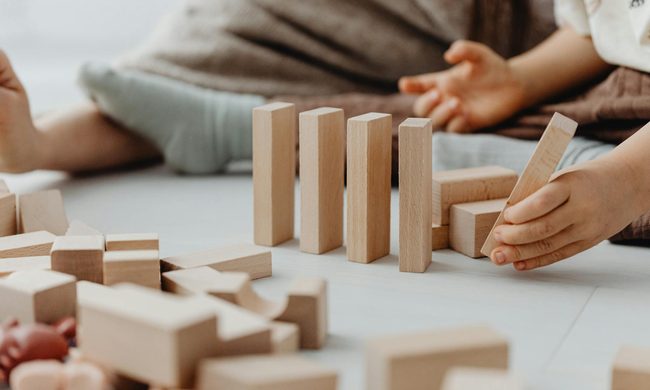
A child playing with stacking blocks

When you’re a new parent, the moment someone gifts your child their first set of blocks, you become obsessed with baby learning and when they should be able to turn the blocks into beautiful creations of their imagination. While stacking blocks are an important developmental milestone for babies, it’s also one of those things that evolves with time and practice. Sitting down to play blocks with your little one is an open-ended game that teaches children physics, resilience, and fun. When can a baby stack blocks and nest cups on their own without your help? Here are some general guidelines so you know how to measure your child’s development with their gift of stacking blocks and how to help your child get the hang of it on their own.
When can a baby stack blocks and nest cups? By age

By 6 months old
At this age, your baby might not be ready to stack blocks the way you want them to, and that's okay. This doesn't mean you can't play blocks with your child or that you shouldn't let your child have fun figuring out what the blocks are. It’s perfectly normal for your 6-month-old to gnaw on blocks or simply hold one, just don't expect them to build the Eiffel Tower just yet.
By 12 months old
This is the stage of banging items against each other and blocks or cups are no the exception. If you offer your child blocks, there may still not be a lot of creativity yet. But keep in mind that knocking things down is a favorite activity of 1-year-olds, so your child is right on track if that's all they do. More likely than not, they’ll be happy to destroy any block tower you build. If your little one can’t get enough of knocking down a stack of blocks, rest assured that they’re right on schedule.
By 18 months old
When can babies nest cups? By a year and a half, stacking is the name of the game. After all, your little one is now officially a toddler and proud of it. If you haven’t done so already, this is a great time to introduce baby blocks. At this point, most kiddos are able to stack two or three blocks on top of each other with ease.
By 2 years old
Don’t be surprised if your baby’s block masterpieces start to get taller by age 2. With improved coordination, your child shows better stacking skills and may be able to balance up to seven blocks on top of each other. This is the beginning of sorting for many young children. If they’re now stacking masters, go ahead and challenge your budding genius to sort their blocks by color or separate them in groups.
By 3 years old
Free play takes a life of its own by age 3. At this point, blocks are much more than meets the adult eye. Your child’s imagination is flourishing, and they’ll start to build tunnels, bridges, or forts with just a few blocks. This is the perfect moment to introduce your toddler to teamwork. If the two of you work together, it’s easier to build tall towers and solve construction problems. Get your child's imagination to full speed and see what they create with blocks of all colors and shapes.
The benefits of stacking blocks

Read more