
Activity tables are toddler staples for a reason — actually, several reasons. Our brains grow to 80% of adult size by age 3 and 90% by age 5, so the importance of providing proper brain stimulation in these early years can’t be overstated. There are many ways you can provide cognitive development opportunities to your little one — and many are simple like just talking to them — but activity tables give your child several ways to grow their brain and body at once.
The activities on these tables can help with language development, problem-solving, learning shapes and colors, visual perception, grasping skills, spatial awareness, standing stamina, sensory stimulation … and fun! They also have so much to do that they will keep your baby engaged for long enough that you can get some rest or chores done. When choosing the perfect activity table for your child, consider these seven features to maximize the benefits.
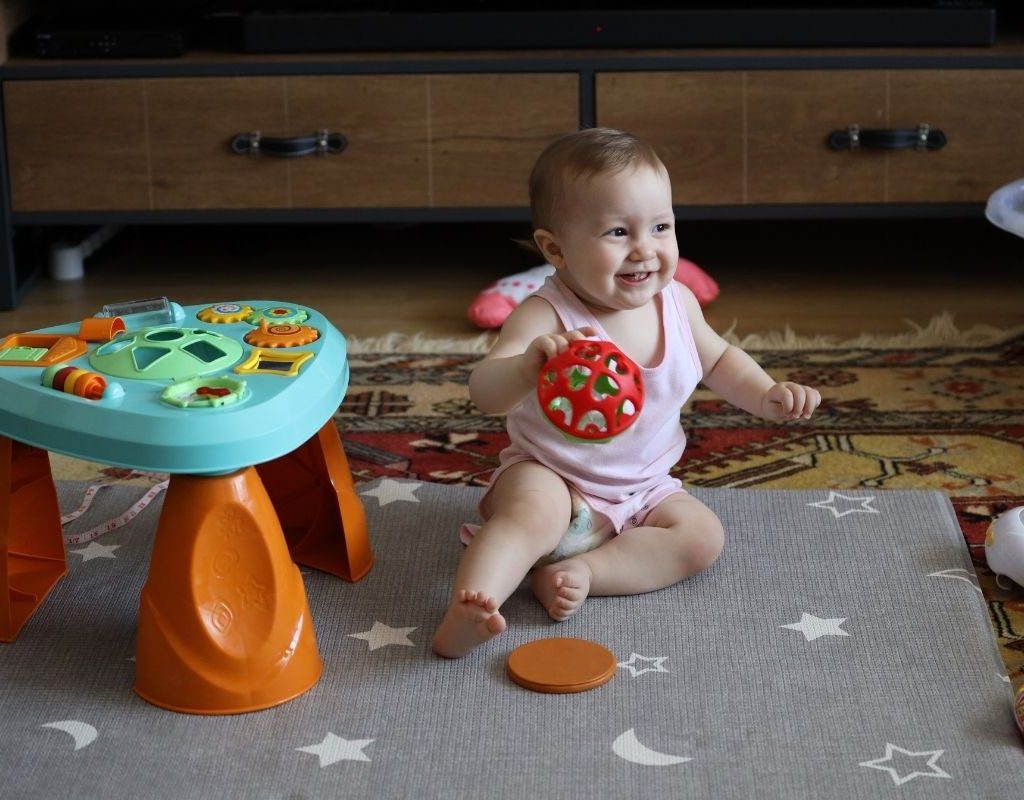
Activities to spin, slide, turn, pull, open, or push
This is, of course, the bread and butter of any activity table — the activities! No baby activity table should be without at least a few interactive features. These could be toy books with one plastic page to turn back and forth, a little door or container to open and close, gears to spin, rings or balls to push along a pole, or tiles to flip or spin. Look for a variety of fine motor skills, meaning not just five toys that spin, but one that spins, one that opens, and so on. This will give your child a diverse set of exercises for their little hands and also keep their brain working hard as they figure out how to maneuver each activity. Not to mention, it will hold their attention longer!
Maze
Many baby-learning tables have some version of a maze, but they usually have just one path to follow. A baby just learning to stand with the help of their activity table isn’t ready for a maze with multiple dead ends, but they can push one ball or other trinket along a set route. These are a common learning-table feature for a reason, as it helps hand-eye coordination and spatial awareness along with other important developing skills.
Mirror
Baby mirrors are made of a flexible material instead of breakable glass. This is a smart feature to look for in a baby activity table because your baby will often be playing at it alone, which is a positive for independent play, but not very social. Let them see a baby face smiling back at them in the reflection to keep developing their eyesight and social skills.
Musical buttons
Look for buttons that light up, play music or a certain sound or a recording of a person saying a word or phrase. Piano keys are a common feature, but any button will do. If you want a battery-free and music-making table, you can still look for a wooden xylophone or other ways to make music on a table. If you do go with a battery-operated table, look for volume options (including an off switch) and a safe battery compartment your baby could never open.
Ramp
Babies adore practicing with cause and effect, and rolling a ball down a ramp and watching it fall off the table or into a hole is just that. Look for a table that gives some kind of rolling option that is self-contained instead of separate balls that will roll away and get lost. The Buy at Amazon comes with animal toys with wheels to send down a ramp, and while the toys aren’t attached to the activity table, the animals stand alone as fun toys to use without the table.
Sturdy base
Some activity tables are only made for toddlers who are confidently standing, so make sure if your baby is just learning to stand that you get a table with a wide base so that it won’t fall onto your baby if they pull to stand with it. Pay attention to suggested age limits, product descriptions, and reviews to see if the table you’re considering is appropriate for your child’s physical development level. If they’re still very little, it might be time for their first playmat instead.
Versatility
Little kids grow so rapidly (both physically and mentally) that any time you see “3 stages in 1” or “grows with your child,” you’re right to jump on it. Some activity tables evolve from play mats or bouncers for babies into activity tables for toddlers into tables for preschoolers. Some have removable legs that make them portable, or the table itself can even fold for storage or travel. The Oribel PortaPlay Baby Activity Center is a perfect example of an “all-in-one” multistage activity center.
Your little one is sure to have fun while developing their fine motor and gross motor skills with activity tables that feature these seven characteristics. Any one you choose will have bright colors and a variety of activities, but make sure it’s also safe and long-lasting, and you’ll be set up for success.